
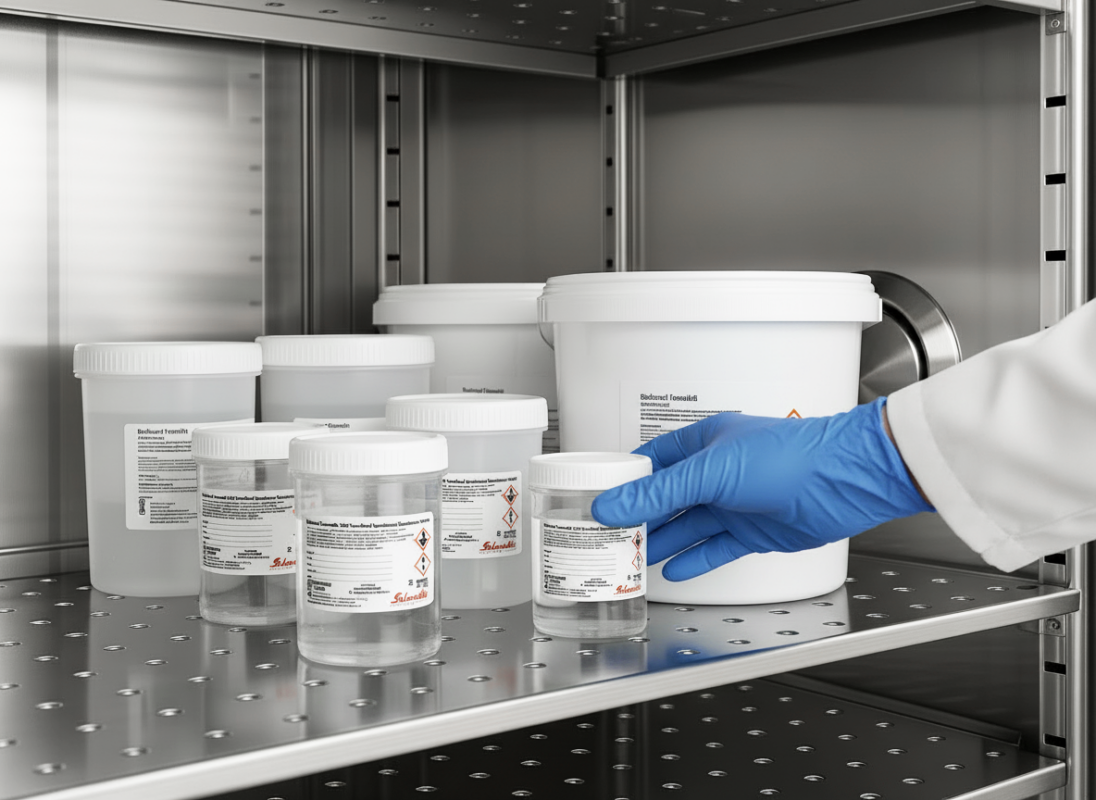
Most histology laboratories use 10% neutral buffered formalin (NBF) as their routine fixative. Over the past decade, many services have moved away from manually filling specimen pots from bulk formalin and instead adopted pre-filled formalin containers, supplied either to clinical areas or used internally in specimen reception and cut-up rooms.
The key question is no longer whether pre-filled containers are convenient, but whether they deliver measurable time and cost savings at scale — and how they compare with other alternatives, such as formalin dispenser units.
This article examines where the time savings genuinely arise and how large those savings are in practice,.
Why Laboratories Use Pre-Filled NBF Containers
Compared with manually filling pots from bulk fixative, pre-filled containers remove or significantly reduce:
- Measuring and dispensing formalin
- Applying hazard labelling
- Handling bulk chemical stock
- Cleaning dispensing stations and managing spills
- Staff exposure management and COSHH controls
- Stocking empty pots and fixative separately
They also standardise the formalin-to-tissue ratio (typically ~10:1), which improves fixation consistency and reduces downstream rework.
Importantly, the efficiency gain per specimen is small — measured in seconds rather than minutes — but across tens of thousands of specimens per year, the cumulative effect becomes operationally meaningful.
Where the Time Savings Come From
Specimen Receiving and Cut-Up Room Setup
Manual filling typically involves:
- Retrieving an empty pot
- Dispensing formalin
- Securing the lid
- Wiping the exterior
Estimated time: 15–40 seconds per container
Pre-filled containers involve:
- Retrieving the pot
- Verifying and using
Estimated time: 5–10 seconds per container
Net saving: ~10–30 seconds per specimen
This saving is small in isolation but significant at scale.
Reduced Chemical Handling and Interruptions
Pre-filled containers reduce the need for:
- Refilling dispensing systems
- Preparing buffered formalin
- Managing spills and leaks
- Checking concentrations and expiry
- PPE-intensive chemical handling
In a typical medium-volume laboratory, this equates to:
5–15 minutes per day, or 20–60 hours per year.
Workflow Consistency (The Hidden Time Saver)
Standardised fixation reduces:
- Under-fixed specimens
- Troubleshooting at cut-up
- Processing delays
- Repeat work for IHC and molecular testing
While harder to quantify precisely, many laboratories report:
1–3 technician hours per week saved indirectly, equivalent to 50–150 hours per year.
This “hidden” saving often exceeds the raw per-specimen handling time.
Using a conservative technician rate of £22–£35 per hour, Estimated annual labour value:
- Small lab: £2,000–£7,000
- Medium lab: £4,000–£14,000
- Large lab: £10,000–£28,000
Even if pre-filled containers cost rises more per unit, labour savings frequently offset — or exceed — the additional consumable spend. savings and operational efficiency, pre-filled formalin containers consistently provide the stronger overall benefit.
Pre-filled 10% neutral buffered formalin containers offer more than just convenience—they provide measurable operational and financial benefits for histology laboratories. While the time saved per specimen may seem small, the cumulative effect across thousands of samples translates into hundreds of hours annually, reduced rework, improved workflow consistency, and lower chemical handling risks. For labs of all sizes, adopting pre-filled containers is a practical strategy to increase efficiency, enhance safety, and free technician time for core diagnostic work, making them a worthwhile investment.